

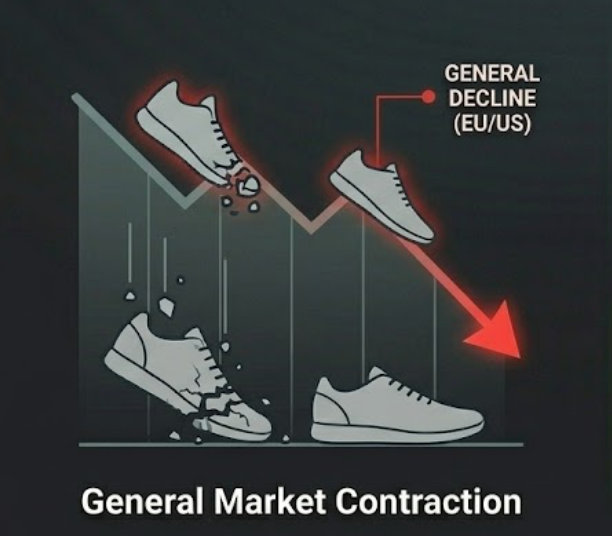
The global sneaker market is experiencing a verifiable contraction. A recent report by Heuritech, published on FashionNetwork, indicates that sales in the European market will fall by 5 percent in the fourth quarter of 2026 compared to the same period in 2025. The United States market is forecast to see a 3 percent decline over the exact same timeline.
Brand Dominance and Shifting Visibility
Market share remains heavily concentrated. Nike, Adidas, and New Balance accounted for 74 percent of the global market in 2025. Nike currently maintains a 34 percent share, followed by Adidas at 26 percent and New Balance at 14 percent.
Visibility is shifting toward different competitors. Mizuno recorded a 44 percent visibility increase in the women's category in 2025. Skechers maintained steady growth in the men's category with a 22 percent increase compared to 2024. Mid-market brands Asics and Onitsuka Tiger also demonstrated strong market share gains over the year.
Performance and Retro Trends
Performance running shoes currently hold the largest market share. Heuritech data indicates that retro sneakers are the only segment projected to grow for both genders in 2026. Specific models reflecting these categories are showing significant volume increases. The Puma Speedcat saw 206 percent growth among women, while the Adidas Adizero grew 150 percent among men in 2025.
Strategic Adjustments for a Contracting Market
A shrinking retail market directly impacts trading margins on the secondary market. When overall sales volume declines and fewer retail buyers enter the space, sellers often lower their asking prices to liquidate excess inventory.
Operating on traditional physical platforms during a contraction forces sellers to pay static shipping costs and verification fees on depreciating assets. Utilizing a tokenized vaulting system like METAZ removes these physical logistics costs entirely. Minimizing transaction fees is a practical requirement for maintaining profitability when retail and resale markets contract.