
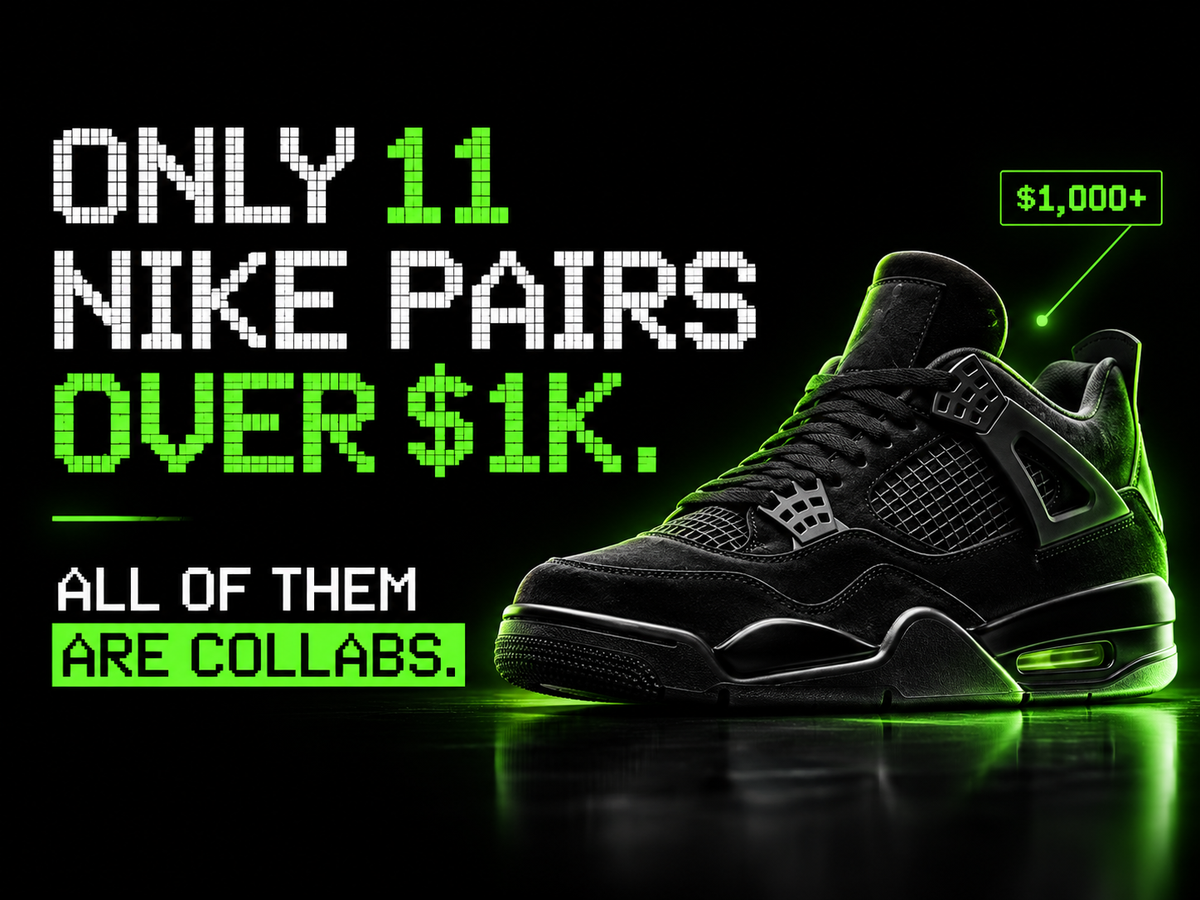
The premium sneaker market has gotten much smaller.
Across thousands of Nike models trading on the secondary market, only 11 currently have a median resale price above $1,000.
Every single one is a collaboration.
That distinction matters because it shows where scarcity still holds value in a market where most sneakers no longer command meaningful premiums.
The $1,000 club is tiny
Recent resale data covering the 90 days through September 2026 found that just 11 Nike sneakers consistently traded above a $1,000 median.
At the top sits the Off-White x Nike Air Force 1 “MCA,” with a median resale price of roughly $1,653.
The Off-White Air Presto from “The Ten” sits around $1,511.
The Tiffany & Co. Air Force 1 is around $1,455.
The Ben & Jerry’s “Chunky Dunky” SB Dunk is roughly $1,373.
And the Travis Scott SB Dunk sits around $1,233.
These are not isolated record-breaking auction sales. They are median transaction prices across multiple sales, which makes the pattern more useful.
Premium resale still exists.
It is just concentrated in a very small part of the market.
Scarcity alone is no longer enough
There was a period when “limited” was almost sufficient to create a resale premium.
Brands could restrict supply, attach a release to a recognizable silhouette, and buyers would often pay above retail immediately.
That relationship has weakened.
Nike alone has thousands of products circulating through the secondary market. Yet only a tiny fraction now maintains four-figure pricing.
The common factor among those that do is not simply low production.
Off-White represents Virgil Abloh and a specific period in sneaker design. The Tiffany collaboration connects Nike to one of the world's most recognizable luxury brands. Ben & Jerry's turned an SB Dunk into an immediately identifiable collectible.
The collaboration becomes part of the asset.
That history cannot be reproduced simply by releasing another limited colorway.
The market is separating product from collectible
This is the same split appearing elsewhere in sneakers.
Most footwear behaves like a consumer good.
It releases, demand peaks, supply enters the market, and prices gradually normalize.
A much smaller category behaves more like a collectible.
For those pairs, buyers care about the exact release, authenticity, condition, ownership history and whether the item has been altered or worn.
At $100, those details may change the price by a few dollars.
At $1,500, they can change it by hundreds.
That makes the infrastructure around the asset increasingly important as the value rises.
A $1,500 sneaker has a provenance problem
Physical sneakers do not come with a native ownership ledger.
Every time a premium pair changes hands, the next buyer has to reconstruct trust.
Is it authentic?
Is this the same pair t
hat was originally verified?
Has its condition changed?
Has it been swapped?
Where has it been stored?
Traditional sneaker resale solves this by repeatedly moving the physical asset through intermediaries.
That works, but it is inefficient.
The most valuable pairs are precisely the pairs that should move the least.
Authenticate the asset. Move the ownership.
METAZ approaches premium sneakers differently.
A pair enters the vault and is authenticated once. Its verification and ownership record can then exist independently from the movement of the physical sneaker.
The sneaker stays stored while ownership trades digitally.
For a general-release pair worth $80, that structure may be unnecessary.
For the handful of sneakers still trading consistently above $1,000, it starts to make much more sense.
Because the resale market is revealing something important.
The premium segment is not disappearing.
It is becoming more selective.
Thousands of sneakers can trade as products.
Only a few become assets.