
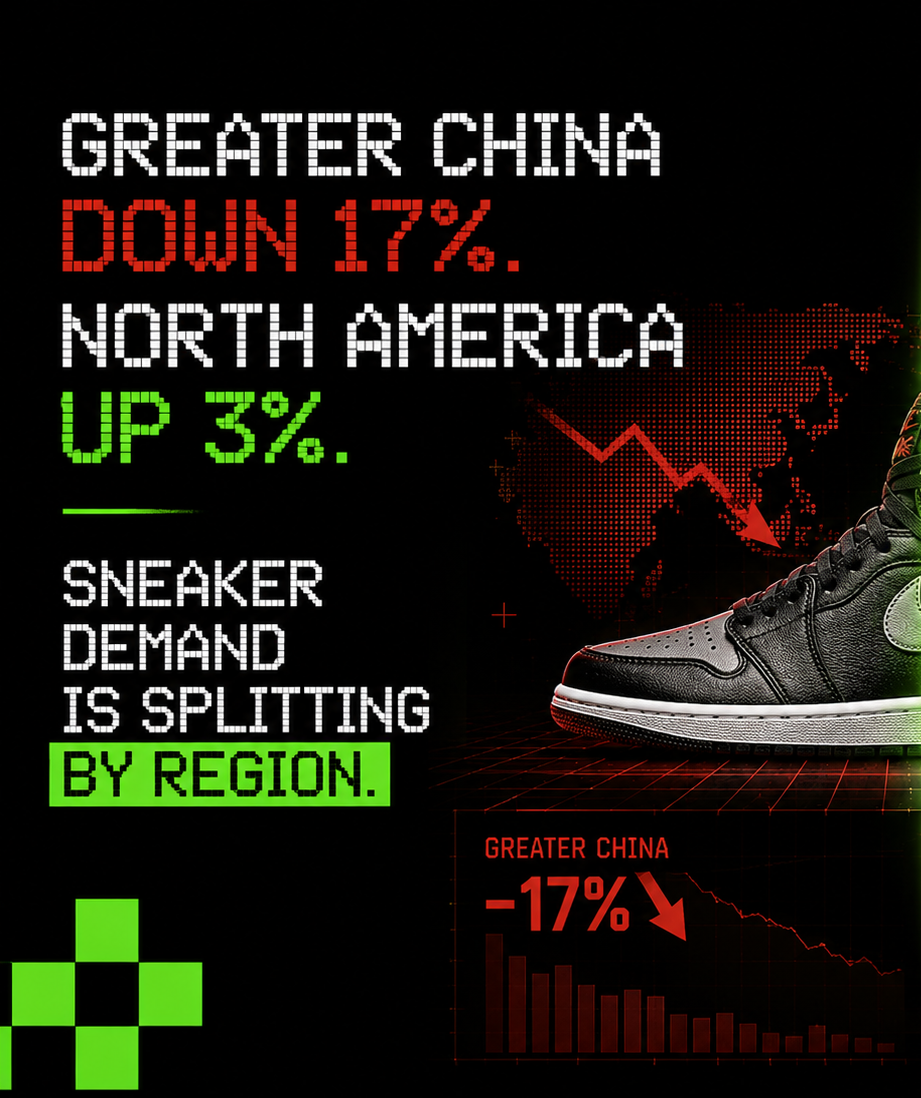
Nike's fiscal 2026 fourth quarter shows the same brand performing very differently depending on where the buyer is standing. For anyone holding inventory in one place, that is a liquidity problem.
The regional numbers in Nike's fiscal 2026 fourth quarter diverge sharply.
North America grew 3 percent to $4.83 billion. Greater China fell 12 percent on a reported basis to $1.29 billion, and 17 percent currency-neutral, with footwear revenue in the region down 13 percent. EMEA slipped 1 percent to $2.97 billion, and 6 percent currency-neutral.
For the full fiscal year, Greater China revenue was $5.85 billion, down 11 percent. Nike's strongest year in the region was fiscal 2021 at $8.29 billion. The decline from that peak is roughly 30 percent.
Where the demand went
It did not disappear. Anta and Li-Ning have taken share, helped by a domestic "China Chic" preference among younger buyers. Both now read as performance brands with cultural weight rather than budget substitutes.
We covered a version of this when New Balance was ascendant. Brand rotation is normal and it happens on a cycle. What is different here is that the rotation is regional. A silhouette can be cooling in one market while it holds in another, at the same moment.
Why that is a problem for physical inventory
A pair sitting in a US verification center is priced by US demand. If the strongest bid for that pair is in Seoul or Shanghai, reaching it means shipping, customs, an import duty, and a second round of platform fees.
Most of the time the seller does not attempt it. The pair clears at the local price, and the spread between local and global goes uncaptured. Cross-border friction is why regional prices for identical items can diverge and stay diverged.
This is fragmentation at the infrastructure level. Supply sits split across regional facilities, so demand cannot aggregate against it. Price discovery happens inside each region separately, which produces a worse price in every region than a single order book would.
The European contraction we covered in May reads differently against these numbers. EMEA weakness and North American growth in the same quarter are not one market softening. They are separate markets moving apart.
What consolidating demand requires
The physical pair has to stop being the thing that moves.
METAZ vaults pairs across authentication centers in the US and Asia, then trades ownership as a token. A buyer anywhere transacts against the same supply in the same order book, without the pair crossing a border. Redemption of the physical item stays available on demand, and it becomes a decision separate from the trade.
That structure matters more as regional demand diverges. When a silhouette softens in one market and holds in another, a global order book routes the pair toward the bid that exists. Regionally held inventory routes it toward whichever bid happens to be nearby.
Nike's fiscal 2026 makes the divergence measurable. The open question is whether inventory can follow it.