

The immediate countdown to April 3rd, 2026, has begun. For the sneaker community, this date marks the wider release of one of the most anticipated collaborations of the decade: the V.A.A. x Nike x Air Jordan 1 Retro High OG SP “Alaska.” This drop, set for SNKRS and select global boutiques, is already generating unprecedented noise.
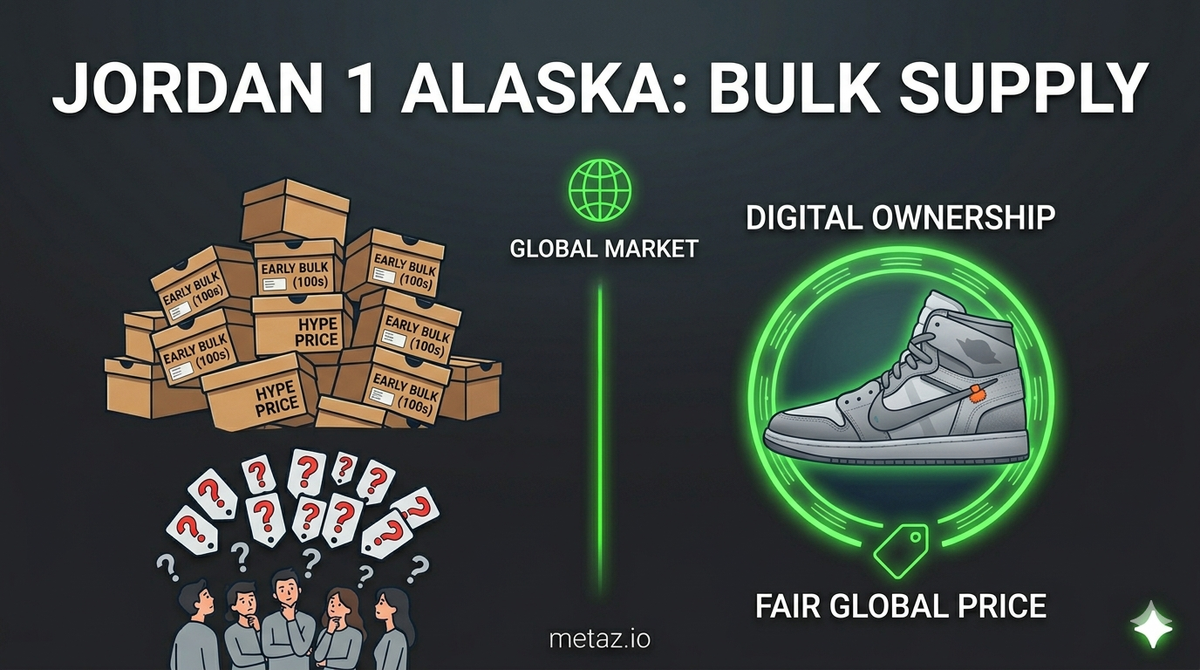
Interestingly, the narrative around the "Alaska" Jordan 1 is shifting rapidly as we approach the release deadline. While early rumors suggested extreme scarcity, recent logistical movements tell a different story. Highly reliable sources indicate that major reselling groups have already begun receiving early pairs of the V.A.A. collaboration—not in single digits, but in bulk shipments of 100 or more pairs per group.
Furthermore, supply-side intelligence suggests a significantly healthier stock allocation than previously believed. Several retail boutiques that have historically been excluded from high-heat Off-White or V.A.A. releases are confirmed to be receiving inventory for this launch. This confluence of data—bulk early arrival and broader retail distribution—raises critical questions about how hyped sneakers are valued during the volatile pre-release window.
Resellers have begun to receive their pairs of the V.A.A. for Nike x Air Jordan 1 Retro High OG SP “Alaska” in bulk of 100's 🕊️🥶📈
— KicksFinder (@KicksFinder) March 19, 2026
The wider release date for boutiques and SNKRS is April 3rd, 2026
Some boutiques that have never gotten Off-White before will be receiving them 👀… pic.twitter.com/m95KEjaMsd
The Smoke and Mirrors of Scarcity
The fundamental driver of inflated sneaker prices on the secondary market is perceived scarcity. In the traditional resale model, brand silence regarding production numbers is the most powerful tool high-volume resellers possess. By maintaining total opacity around stock levels, sellers are free to fabricate narratives of extreme limitation to justify exorbitant pre-order asking prices.
When the market is "dark"—operating without verifiable data on supply—fear of missing out (FOMO) dictates the price. The V.A.A. Jordan 1 "Alaska" is the perfect case study. If buyers believe only 10,000 pairs exist worldwide, a $2,000 price tag might seem rational to a dedicated collector. However, if true supply is closer to 100,000 pairs, that price point is an artificial bubble sustained only by a lack of market transparency. The current bulk receipts by resellers suggest the market is being deliberately manipulated by those holding early inventory, banking on consumer ignorance regarding the true, higher stock numbers.
The Need for Transparent Price Discovery
At METAZ, we operate as a peer-to-peer resale platform, but we are deeply committed to the concept of fair and transparent price discovery. The current system is fundamentally inefficient because it forces collectors to make high-stakes financial decisions based on rumor rather than reality. We believe that a healthy sneaker ecosystem is one where the final transaction price reflects the true equilibrium of global supply and demand, not the artificial constraints engineered by a few market movers.
True price discovery requires illuminating the shadows of the market. Opaque markets serve only the middleman; transparent markets serve the collector. We aim to build an infrastructure where information parity exists between buyer and seller, ensuring that when you purchase a grail like the "Alaska" Jordan 1, you are paying a price rooted in factual global availability.
Breaking Regional Barriers to Aggregate Supply
The traditional physical sneaker market is fragmented by geography. Launching pairs simultaneously across different SNKRS regions (US, EU, Asia) and localized boutique raffles creates artificial, regional pockets of scarcity. A specific size may be abundant in Tokyo but nearly impossible to locate in New York, leading to massive price disparities based solely on a buyer’s location. This fragmentation prevents true global liquidity and allows localized "hype bubbles" to form.
METAZ is designed as a regionless platform to solve this precise limitation. By utilizing digital ownership tokens backed 1:1 by physical sneakers secured in our vault, we eliminate geographical friction. When a pair of V.A.A. Jordan 1 "Alaska" enters our custody, it is no longer isolated in a specific country. It becomes part of a single, continuous, global pool of inventory.
This aggregation fundamentally changes the supply dynamic. A buyer in London is trading in the exact same market as a seller in Singapore. By combining the fragmented global supply into one borderless ecosystem, we effectively increase the available stock for every user worldwide. This consolidated marketplace makes it significantly harder for regional shortages to artificially inflate prices. When all global inventory is visible and tradable in one place, the resulting price is the most accurate reflection of the shoe’s actual value. Digital ownership doesn't just lower fees; it democratizes access to the global supply.