
Resale prices are quoted against retail. Nike's fiscal 2026 shows how little that reference number has to do with the shoe.
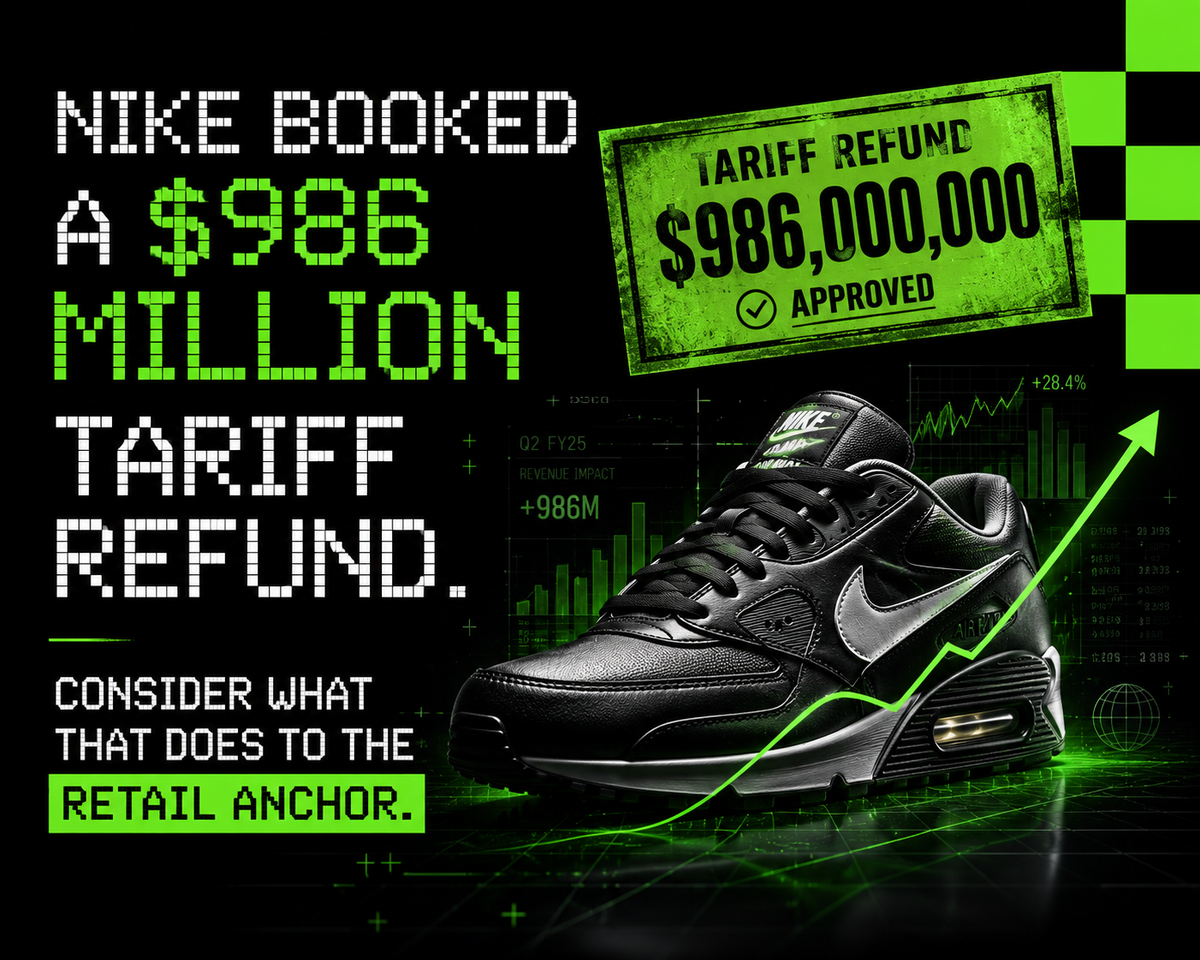
Start with Nike's own reporting. In its fiscal 2026 fourth quarter, gross margin rose 890 basis points to 49.2 percent. Roughly 900 of those basis points came from one line: the expected recovery of $986 million in tariffs paid under the International Emergency Economic Powers Act. Diluted earnings per share was $0.72, of which $0.52 was that recovery. Net income rose 407 percent to $1.06 billion.
Take the refund out and the quarter reads differently. Revenue fell 1 percent on a reported basis and 4 percent currency-neutral.
How the money moved
IEEPA tariffs took effect in February 2025. In April 2025, Nike joined other footwear companies in signing a Footwear Distributors & Retailers of America letter warning that tariffs would cause significant price increases. Starting June 1, 2025, Nike raised prices, including $5 to $10 on select footwear and up to $10 on apparel and equipment.
On February 20, 2026, the Supreme Court held that IEEPA did not authorize those tariffs. A uniform 10 percent Section 122 rate replaced them four days later.
A consumer class action filed in the District of Oregon on May 8, 2026 alleges Nike stands to recover the same cost twice, once from buyers through higher prices and again from the government through refunds. The complaint describes this as a windfall. Nike has not conceded the point, and the plaintiffs face real hurdles on causation and class certification. The case is Caldwell v. Nike, 3:26-cv-00923.
Why resale should care
Set the litigation aside. The pricing mechanics are the part that matters here.
Retail price is the reference point nearly every resale conversation starts from. Above retail, below retail, percentage over retail. That framing assumes retail says something about the product.
Fiscal 2026 shows retail also reflects trade policy, a legal challenge to that policy, and a company's decision about what to do once the policy is struck down. A pair carrying a $10 tariff adjustment is the same pair it was in January 2025. The number attached to it moved for reasons that had nothing to do with the shoe, and the resale market repriced against it anyway.
This is a version of the opacity problem we have written about before. When the anchor is set privately and adjusts for reasons buyers cannot observe, every price quoted against it inherits that uncertainty.
A more durable reference
A better reference is what a specific item actually traded for, recorded somewhere both parties can check.
METAZ writes verification and ownership history for every vaulted pair to a public blockchain. The trade history of a tokenized pair is auditable by anyone, without requesting access to a platform's private database. Price discovery then runs off observed trades rather than a retail figure that moves with customs policy.
Retail will keep moving. The trade record does not have to.