

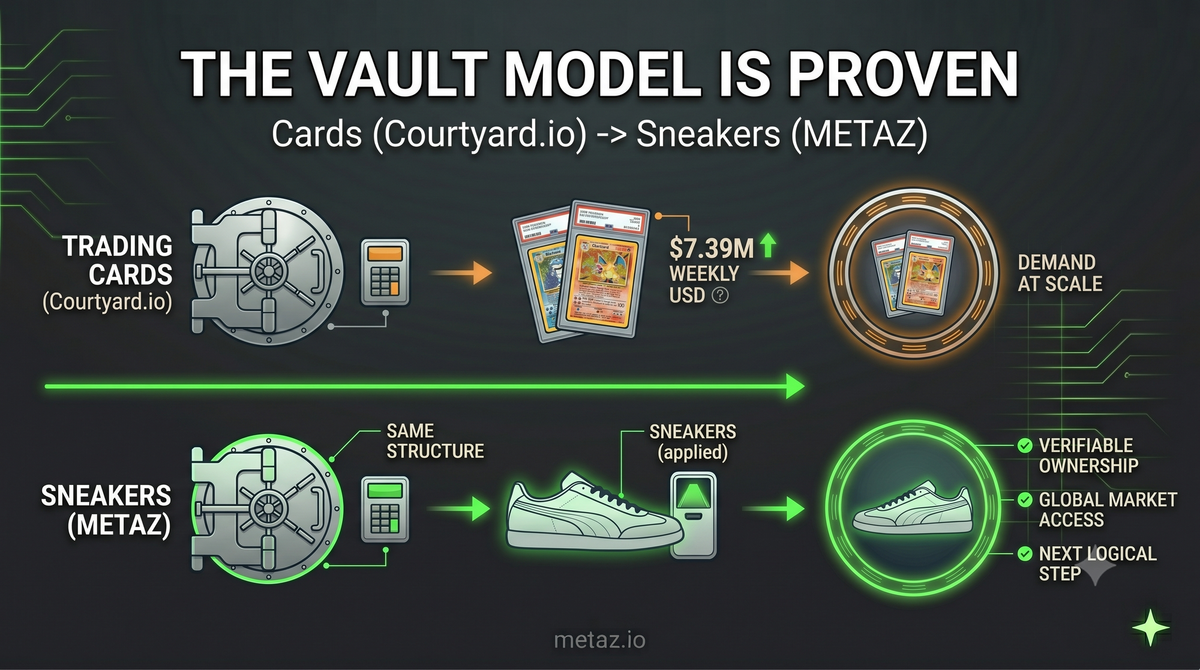
Courtyard.io tokenizes graded cards held in a vault and moves eight-figure monthly volume doing it. Sneakers have no equivalent. The reason is grading, not blockchain.
Courtyard.io runs on Polygon and does one thing. Physical collectibles go into a vault, get tokenized, and the token trades. The holder can redeem it for the physical item at any time. The inventory is primarily graded Pokémon cards and sports cards.
The volume is real. Courtyard recorded roughly $78 million in Pokémon secondary volume in August 2025. For the week of May 17, 2026, it posted $7.39 million in sales and topped weekly marketplace rankings on Polygon. Its supply now exceeds 5.1 million tokenized items.
That is the same structure METAZ uses for sneakers. Vault the asset, verify it once, trade ownership digitally, redeem the physical item on demand. Cards have already demonstrated the model has demand at scale.
Why cards adopted it and sneakers have not
The answer has little to do with blockchain infrastructure and a lot to do with what existed before tokenization arrived.
PSA grades cards on a published 10-point scale with defined criteria for centering, corners, edges, and surface. Across the industry, roughly 20 million cards were graded in 2024. PSA also publishes a free population report showing how many copies of a given card exist at each grade, updated daily.
That combination does two things. It turns condition into a number two strangers can agree on. And it makes supply at that number publicly countable. A PSA 10 with a population of 12 and a PSA 10 with a population of 5,500 carry very different prices, and either party can look up which one they hold.
Once condition and scarcity are that legible, a token representing a vaulted card carries nearly all the information a buyer needs. The physical object stops needing to move.
Sneakers have grading, but no standard
Sneaker condition grading does exist. GOAT applies a proprietary scale to GOAT Clean inventory, with tiers including Like New, Excellent, Very Good and Good, supported by standardized photography. StockX Listings uses AI photo analysis to pre-fill condition details from seller images.
Both are platform-specific. A GOAT "Very Good" does not transfer to StockX, eBay, or a Discord group chat. There is no shared criteria set, no independent third-party grader, and no public population data showing how many pairs of a given model exist in a given condition. That gap matters because condition drives resale value more than almost any other variable.
That is the real bottleneck. Without a shared condition standard, a token still asks the buyer to trust one platform's private judgment.
What has to be true for sneakers
Three things. Published grading criteria a buyer can check a pair against. Condition assessment that survives a change of platform. Public supply data at each condition level.
METAZ addresses the second and third within its own system. Verification records and ownership history for every vaulted pair are written to a public blockchain, so anyone can audit an item's record without platform permission. Vaulted supply is visible on-chain rather than held in a private database. That is what makes a tokenized sneaker tradeable as an alternative asset.
The first still needs the industry. Cards spent decades standardizing grading before tokenization made sense for them. Sneakers should not need that long, but somebody has to publish the criteria.